|







| |
Tensile Tester:
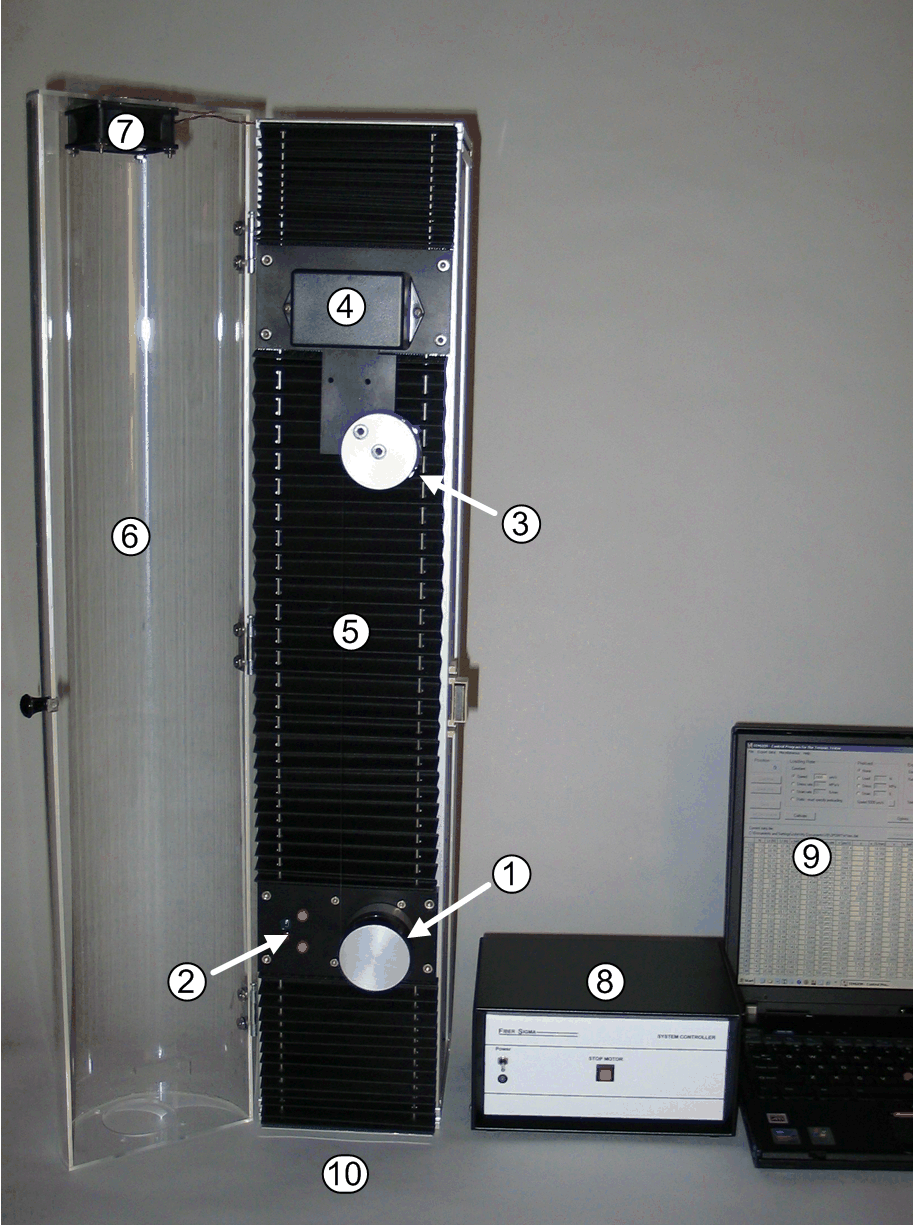
Uniaxial tensile testing is conceptually the simplest
strength measurement technique for optical fiber. It involves gripping the
ends of the fiber and pulling them until failure occurs. The fiber must be
gripped carefully in order to avoid damaging it. Gripping is achieved by
wrapping the fiber around coated capstans. The fiber is then stressed either by rotating one of the capstans to wind in the fiber (Table
Top Tensile Tester) or by
moving the capstans apart (TT-SLIDE option for the Table
Top Tensile Tester). The Table
Top Tensile Tester is recommended for future applications because of its
convenience and versatility (e.g. long gauge length testing).
TENSION
for Windows control software is now available.
We build three different versions tensile testers which have the
following capabilities in common:
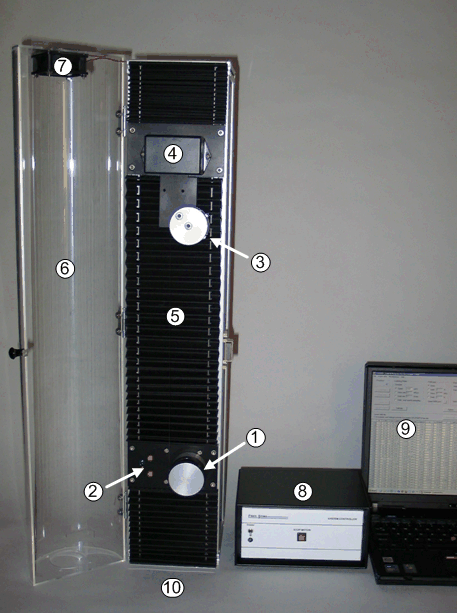
(Click on the picture for a bigger version)
Features
-
A rotating capstan is used to apply load to the fiber. A non-rotating
capstan on a translation stage is available as an option.
-
Manual control of the capstan motor makes loading fiber onto the rotating
capstan easier.
-
The fiber/test specimen is attached to the load cell by wrapping around a
rubber-coated capstan.
-
The fully enclosed precision load cell is protected from flying debris.
-
The rotating capstan and load cell are mounted on plates which can be
moved to provide any test length up to 0.5 meters (1 meter available as an
option). A flexible bellows protects internal electronic and mechanical
components from debris.
-
Strong fiber shatters when it breaks generating flying debris which can be
a danger to eyesight. A transparent door protects the operator from the
debris. A failsafe interlock system warns the operator when the door is open
during a test.
-
A fan in the door ensures that the environment around the fiber is the
same as the surrounding air.
-
The System Controller contains a dedicated high-performance microprocessor
which provides real-time control of the capstan motor. It also contains the
high speed data acquisition system used to measure the load cell signal.
-
Versatile and easy-to-use Windows software controls the instrument. For
example, TENSION for Windows is used for
strength measurement and STRIP for Windows
for coating strip force measurement. The instrument connects to the computer
by either a serial or USB port.
- The instrument is compact with ~ 150 x 150 mm footprint.
 | compact and enclosed with small footprint |
| employs a rotating capstan (although a non-rotating translating
capstan is available as an option) |
| ability to perform long gauge length testing |
Long Gauge Length Option
An option for The Table Top Tensile Tester permits long gauge length testing.
For this option, the body of the tester can be separated into two sections, one
containing the load cell with capstan, and the other containing the rotating
motorized capstan. By mounting these two sections separately, fiber test lengths
of up to 20 meters or more can be achieved. The option includes a pulley so
that, if needed, the fiber can be folded back on itself thus making the system
more compact (as permitted by FOTP-28C).
Fixtures
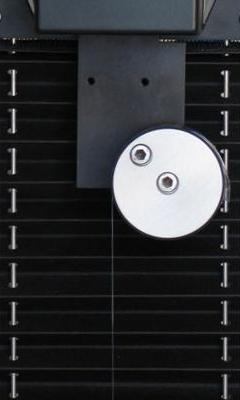
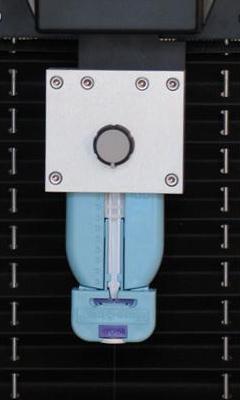
A variety of mounting fixtures can be used with the Table Top Tensile Tester:
| The standard instrument is supplied with a rubber-coated capstan
(left-hand picture) to which the fiber is attached by wrapping around two or
three times. |
| The Coating Strip Force option
replaces the capstan with a holder for a stripping tool (the blue tool is
shown in the right-hand picture). |
| The Coating Pullout Force option
includes a clamping system used to make coating pullout force measurements. |
| An optional pneumatic grip makes attaching the fiber to the load cell very
simple. However, it can only grip a fiber up to loads of ~20 newtons or so,
beyond which slipping occurs. The pneumatic grip is useful for pull tests or
measuring the strength of weak fiber. If the rotating capstan is replaced by a
translating capstan, a second pneumatic grip can be attached to the other end
of the test specimen for even greater ease of use. |
| Custom fixtures can easily be designed to attach to the load cell. The
customer can then attach a variety of fixtures for pull testing components,
connectors, strain reliefs, etc. |
The Table Top Tensile Tester is designed principally for use with standard
telecommunications fiber (125 µm glass diameter)
with failure loads in the range of 5 to 100 newtons. A more robust capstan motor
and load cell can be used for stronger or thicker fiber. Very weak fiber might
break while wrapping around the 50 mm diameter capstans - pneumatic grips
(T4-GRIP) used in conjunction with the translating capstan option (T4-SLIDE) might
be considered. Please contact us to discuss your specific
needs so that we can specify a system that best suits your application.
Load Cell Calibration
The control software has built in features for precisely
calibrating the load cell by hanging test weights on the system using a piece of
string. We do not supply calibration weights due to high shipping costs,
so customers should obtain their own test weights. Please consult any
standard test methods you use for further information.
Specifications
| Maximum load (others load ranges available) |
120 N |
| Load error (linearity, hysteresis,
repeatability) |
< ±
0.07 N |
| Maximum loading rate (½ meter
gauge
length - maximum stress and strain rates
scale
inversely with gauge length) |
5 mm/s
50 %/min
500 MPa/s |
The maximum loading rates are for 125 µm glass diameter
silica optical fibers. Contact us for information on loading rates other
fiber sizes.
Requirements
A PC
running Windows 95 or later with a serial or USB port. Calibration weights are needed to calibrate the
load cell for compliance with standard test procedures.
Options
- Coating Strip Force and Pull-out Force (T4-STRIP)
-
This option
includes fixtures
for measuring Coating Strip Force and
Pull-out Force. Replacement stripping tools are available separately
(T4-TOOL) for a variety of glass and outer coating diameters.
T4-STRIP includes one stripping tool for 125/250 µm
fiber.
- Long Gauge Length Option (T4-LGL)
-
The body of the T4 tester is in two pieces for this
option; one piece incorporates the load cell and the other the rotating
or translating capstan for applying load to the fiber. The two
parts can be mounted an arbitrary distance apart so that a gauge length
of up to 20 meters or more can be used. An included
pulley permits, if desired, folding the fiber into two thus halving the
overall length of the system compared to the gauge length. This option is
not available as an upgrade for existing systems.
-
- One Meter Gauge Length (T4-1M)
-
The standard system is designed for gauge lengths of
up to 0.5 meters, but this option permits gauge lengths of up to one
meter. This option is not available as an upgrade for existing systems.
-
- Translating Capstan Option (T4-SLIDE)
-
The standard system applies load to the fiber by rotating
one of the capstans to wind in the fiber. Optionally the rotating
capstan is replaced by a capstan attached to a slide or translation stage -
the fiber is then loaded by moving both the two capstans apart. Both methods
are permitted by moist standard test methods, but the translating capstan
has some advantages, such as the ability to attach the coating stripping
tool for T4-STRIP to a more robust platform than the load cell.
-
- Pneumatic Grip (T4-GRIP)
-
The standard system grips the fiber by winding around
mandrels. Pneumatic grips are easier to use but do not grip the fiber
well enough for strength measurements. However, a single pneumatic grip
can be used for strip force and pull-out force testing. A pair can be used
for
proof testing. A 75 psi air supply is required to operate the grips. Please
contact us before ordering this option to discuss your requirements.
-
- Extra Tape for Mounting Fibers (T4-TAPE)
-
This option includes one roll of two-sided tape for
coating the capstans, and two rolls of narrow single-sided tape for
covering the fiber on the capstans. Various tape systems have been
tried by a variety of workers, but we find this combination used to form
a "partial escargot wrap" reliably holds the ends of the fiber on the
capstans. Very importantly, if there are any gripping issues
causing premature fiber failure, witness marks on the tape show whether
failure of the fiber occurred in the gauge length or on the capstan.
Contact us for further information.
-
High Load Option for Thick Fibers (T4-400N)
-
The standard system is designed for use
with
standard 125 µm glass diameter
telecommunication
fibers. The system can be used with thicker fibers but a higher
capacity, 400 N
load cell is required. Please contact
us
for information.
-
Low Load Option (T4-50N)
-
A lower capacity load cell option (50 N) is available for
testing very thin or very weak fibers. Please contact us for information.
-
Custom Foam Lined Instrument Case Packaging Option (T4-PKG)
-
This option supplies the Table Top Tensile System packed
into a robust impact and water tight instrument case. The case is
lined with foam with custom cutouts for the tester. This low
cost option is highly recommended.
Ordering Information
| Description |
Part# |
| Complete Table Top Tensile Test system
(including all hardware, electronics, software and cables, but no PC) |
T4 |
| Coating strip force and pullout force option |
T4-STRIP |
| Additional stripping tool for T4-STRIP - please specify
glass and coating outer diameters |
T4-TOOL |
| Long gauge length option† |
T4-LGL |
| One meter gauge length option† |
T4-1M |
| Translating capstan option† |
T4-SLIDE |
| Pneumatic grip option (single) |
T4-GRIP |
| High load load cell option (400 N) |
T4-400N |
| Low load load cell option (50 N) |
T4-50N |
| Custom foam lined instrument case packaging option |
T4-PKG |
† must be ordered at same time as T4.
|